
The full field guide
Wildlife and animals in Tsavo East and Tsavo West
About forty per cent of Kenya's elephants live here, stained the colour of a flowerpot by the soil they throw over themselves. Add lions whose manes arrive late and stay thin, an underwater viewing chamber at Mzima Springs, and most of the last elephants on earth carrying tusks that reach the ground.
If you only want the answer
Red elephants dusted in Tsavo's laterite, the biggest elephant population in Kenya, lions without much mane, and Mzima Springs' hippos in glass-clear water. The scale is the point: this is wilderness the size of a small country, so work the water points and be patient.
Tsavo animals: your odds, species by species
Colour is the shorthand here. Green means you would be unlucky to miss it, amber means it depends on your route and your patience, terracotta means a story to tell at dinner. Tsavo is semi-arid and enormous, so animals sit far thinner on the ground than in Kenya's small famous parks. The trade is that you often get the sighting to yourself.
The bands below assume a three-night trip in the dry months covering circuits in both parks. They are deliberately conservative: a fenced sanctuary or a floodlit lodge waterhole will beat them, and a wet week in April will not come close.
- Elephant Guaranteed Red with Tsavo dust
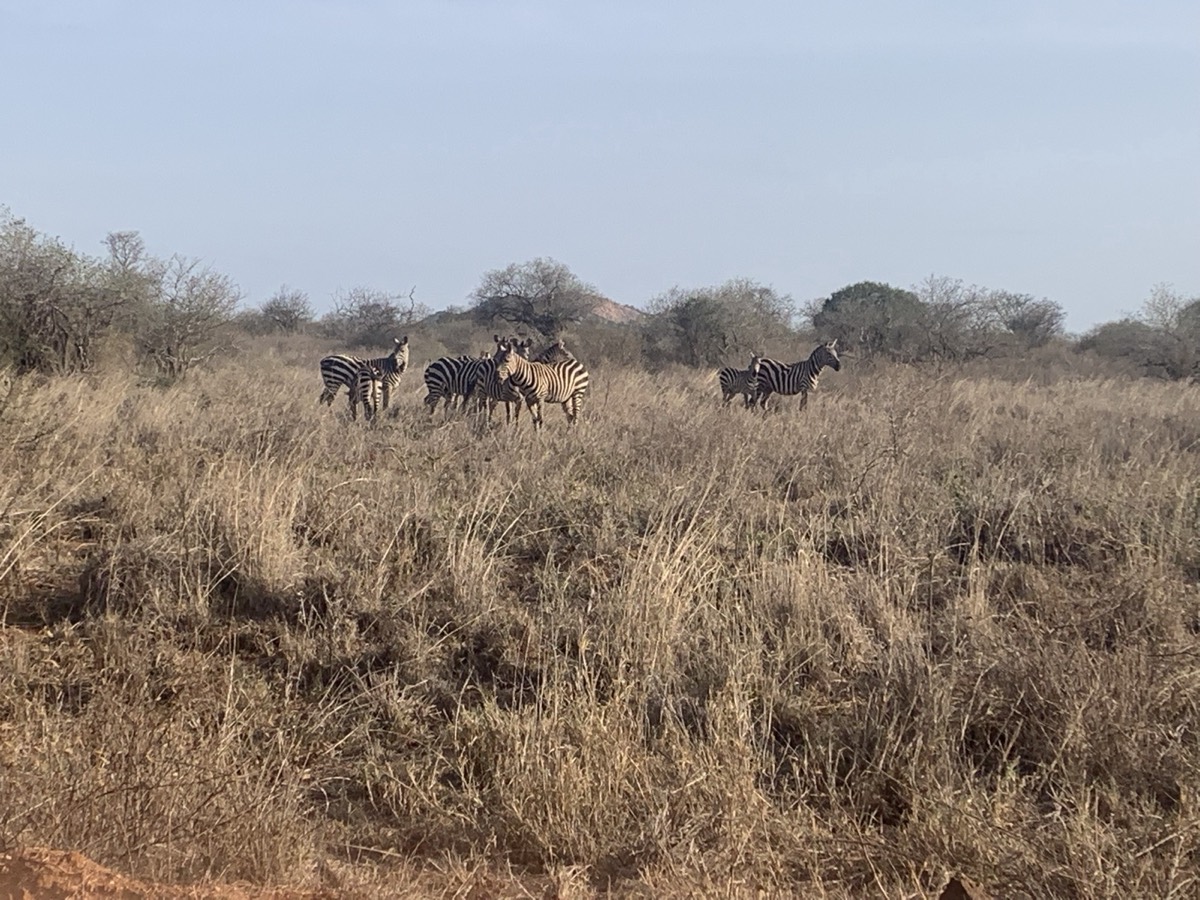
- Plains zebra Guaranteed
- Masai giraffe Guaranteed
- Impala Guaranteed
- Warthog Guaranteed
- Yellow baboon Guaranteed
- Kirk's dik-dik Guaranteed Pairs on almost every track edge
- Buffalo Very likely
- Vervet monkey Very likely Fig trees above Mzima
- Waterbuck Very likely Voi River and the Galana
- Grant's gazelle Very likely
- Gerenuk Very likely Browses on its hind legs
- Lesser kudu Very likely A Tsavo signature, shy in thick bush
- Coke's hartebeest Very likely
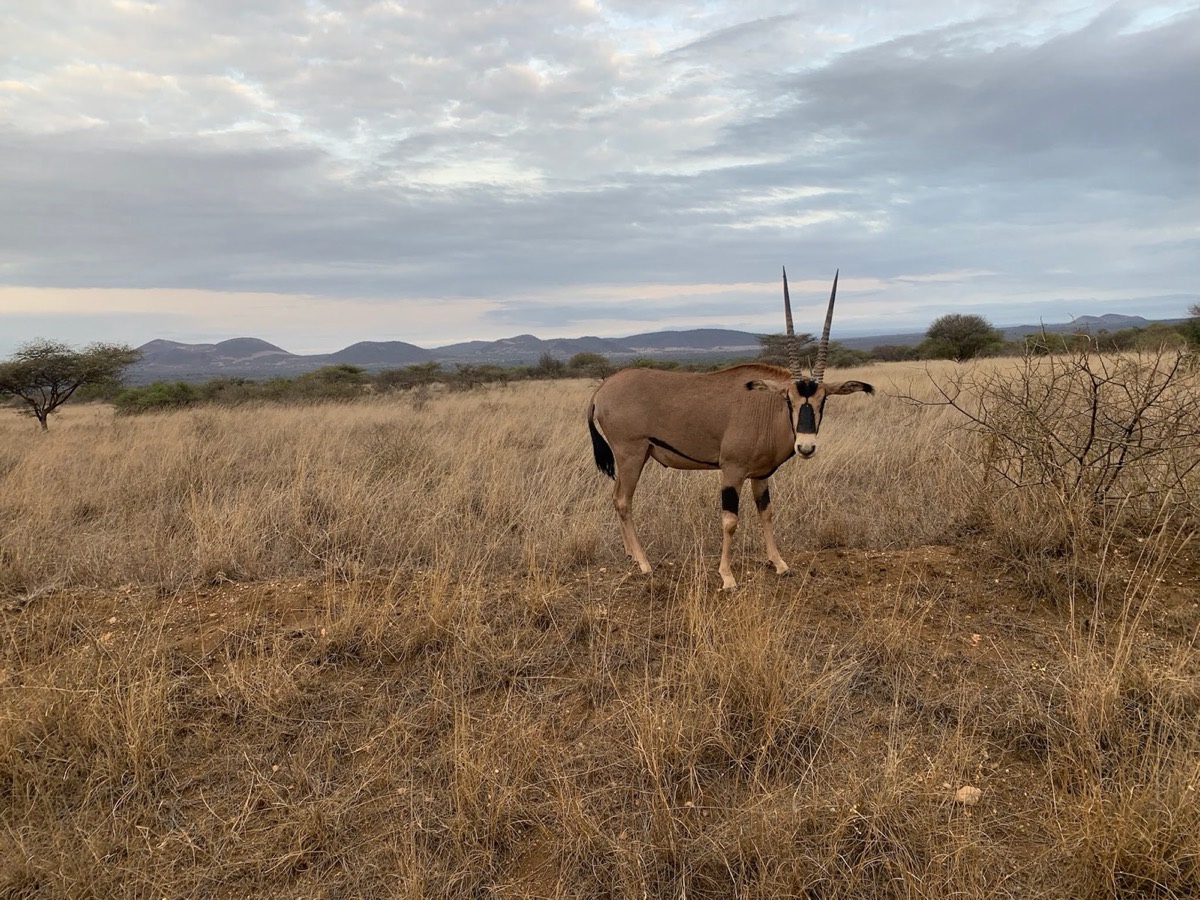
- Fringe-eared oryx Very likely Open red ground in the east
- Hippo Very likely Mzima Springs and Lake Jipe
- Nile crocodile Very likely Galana River and Mzima
- Spotted hyaena Very likely
- Lion Good chance Thin manes, thinly spread
- Eland Good chance
- Bushbuck Good chance Riverine thicket only
- Klipspringer Good chance Rocky outcrops and lava
- Black-backed jackal Good chance
- Leopard Takes luck Night drives improve the odds
- Cheetah Takes luck Open country in the east
- Wild dog Takes luck Present, no published Tsavo estimate
- Striped hyaena Takes luck Nocturnal and scarce
- Caracal Takes luck
- Serval Takes luck
- Honey badger Takes luck
- Bat-eared fox Takes luck
- Aardwolf Takes luck Termite feeder, almost never seen
- Hirola Takes luck ±76 animals, Tsavo East only
- Sable antelope Not here Kenya's only herd is at Shimba Hills
- Roan antelope Not here Kenya's only herd is in Ruma
- Grevy's zebra Not here Northern Kenya only, despite some lists
Bands assume three nights between late June and October, driving both parks. In the long rains of April and May the game spreads away from permanent water and most bands drop a level. Species silhouettes from PhyloPic (CC0, CC BY and CC BY-SA).
Tsavo elephants: the numbers and the red colour
Tsavo is the reason Kenya still has a large elephant population, and the count has been climbing for three decades. An aerial survey flown in February 2011 across 48,319 square kilometres of the Tsavo and Mkomazi ecosystem recorded 12,573 elephants, ninety six per cent more than the 6,399 counted in 1988 after the worst of the poaching years. The Tsavo Trust now puts the area's herd at roughly fifteen thousand, against something like thirty five thousand in the late 1960s.
Two details from that census are worth carrying with you. Half the elephants counted were in Tsavo East and seventeen per cent in Tsavo West, but twenty two per cent were on the Taita ranches outside either park, and thirty one per cent of the whole population was on unprotected land on the day of the count. The corridors between and around the parks are not a footnote to Tsavo's elephants, they are a third of the story.
The red is not a species trait, whatever the postcards imply. Tsavo's soil is a fine iron-rich laterite, and elephants spray and wallow in it all day, which leaves them terracotta until the next storm rinses them back to grey. It is the single reason photographs taken here look unlike photographs taken anywhere else in Kenya.
For reliable viewing, get above the water rather than beside it. Mudanda Rock in Tsavo East is a long outcrop with a dam at its foot, so you park, walk up and look down on whatever has come to drink. Aruba Dam on the Voi River does the same job at eye level, and several lodges floodlight a waterhole once the gates have shut.
The great tuskers, and how few are left
A great tusker is an elephant whose ivory is heavy enough to reach the ground, conventionally taken as more than a hundred pounds a side. The Tsavo Trust, which flies the conservation area jointly with Kenya Wildlife Service, estimates around twenty five survive anywhere in Africa and says most of them are here. That is the most remarkable thing about this park and also the most fragile.
Three names come up constantly. Satao, probably the best known elephant in Kenya, was killed by poachers in May 2014. Satao II was killed in 2017 at around fifty years old. Dida, called the queen of Tsavo and widely described as the largest tusked female in Africa, died of old age in 2022 at somewhere between sixty and sixty five, which under the circumstances counts as a good ending.
Between 2013 and 2021 the joint Tsavo Trust and Kenya Wildlife Service aerial programme logged 9,260 flying hours across 734,750 kilometres, made 860 arrests and lifted 5,880 snares. None of that makes a tusker something a lodge can promise you. Most visitors will not see one, and anybody who guarantees it is selling you something.
Maneless lions, and what the research actually found
Tsavo's males are famous for having no mane, and the two lions that stopped work on the railway in 1898 were both bare-necked. The popular version, that Tsavo lions are simply maneless, does not survive the one serious study of the question.
Gnoske, Celesia and Kerbis Peterhans compared lions from the greater Tsavo ecosystem with lions from the equatorial plains and published in the Journal of Zoology in 2006. Eighty seven per cent of the Tsavo males they examined did have a mane, and forty nine per cent had what they classed as a good one. What differed was timing. Manes here develop late and stay poor for the animal's age, and the pattern follows heat rather than genetics.
That fits the wider science. West and Packer showed in Science in 2002 that a dark, heavy mane costs a lion in body temperature and sperm quality, and that males carry lighter and shorter manes in hotter seasons and hotter habitats. Tsavo is low and hot. The 2006 study also found that poorly maned but fully mature males were mating normally, so a thin mane here says nothing about the age or the status of the animal in front of you.
How many lions Tsavo holds is a question nobody can currently answer. The figure that circulates, about 675, covers the whole Amboseli and Tsavo ecosystem and dates from 2006. No newer park-level estimate has been published, so this one is twenty years old. Expect small groups, wide spacing, and much harder searching in the thick green bush after rain.
The two lions that caused all this in 1898 have their own page, including what the isotope study found about how many people they actually killed.
Mzima Springs and the window under the water
Rain that fell on the Chyulu Hills spends roughly twenty five years working through porous volcanic rock before it surfaces fifty kilometres away at Mzima. It arrives filtered to near transparency, which is why Tsavo West has the one piece of wildlife infrastructure in Kenya with no real equivalent: a chamber sunk into the pool so you look sideways into the water instead of down at it.
The chamber was built for hippo and Nile crocodile, plus the fish that crowd the clear water. Whether the hippos oblige is a different matter. Mzima held around seventy hippos in 2003 and the drought of 2009 cut that to five. There has been no published count since, so treat the walk as an unusual thing to do rather than a guaranteed sighting.
The hippos underwrite everything else at the springs. They graze the surrounding bush at night, return to the pools by day, and their dung fertilises the water, which feeds the fish, which feed the cormorants and kingfishers. A short bank trail runs with an armed ranger, and vervet monkeys work the fig trees over it.
East or west: what actually changes
| Where | What it gives you |
|---|---|
| Tsavo East, Voi and Aruba circuits | The red elephants at their best, plus buffalo, oryx and hartebeest on open ground. The easiest driving in either park and the busiest sector |
| Tsavo East, Mudanda Rock and Lugard's Falls | Elephant viewing from above the water at Mudanda, crocodile below the falls, and the Yatta Plateau on the skyline all the way north |
| Tsavo East, northern area beyond the Galana | Very few vehicles, elephant that have never learnt to ignore a car, and no realistic self-drive access. Reached from the Ithumba camps |
| Tsavo West, Mzima and Kilaguni | Hippo and crocodile underwater at Mzima, klipspringer on the lava, and a permanent lodge waterhole with Kilimanjaro behind it |
| Tsavo West, Ngulia escarpment | Long views over the plains, a floodlit waterhole below the escarpment, and in November and December the best songbird migration in East Africa |
| Lake Jipe, far south of Tsavo West | The best water birding in either park, hippo and crocodile, and elephant coming down to drink with Tanzania on the far shore |
The dry-country antelope, which is what Tsavo does best
If you have already done the Mara, this is the part of the list that will be new. Tsavo is Somali and Masai thornbush rather than grass plain, and it holds the browsers that the famous grasslands do not.
The gerenuk is the one to watch for. It feeds by rising onto its hind legs and using an absurdly long neck to strip acacia above the reach of every other antelope, and it barely drinks at all, taking its water from the leaves. Lesser kudu are here in good numbers, grey and finely striped and far more nervous than their southern African relatives. Fringe-eared oryx cross the open red ground in the east, and Kirk's dik-dik freeze in pairs at the edge of nearly every track.
The rarity is the hirola, a critically endangered antelope whose natural range is the border country between Kenya and Somalia. Animals were moved into Tsavo East in 1963 and again in 1996 as an insurance population, and successive surveys have found that group holding at roughly seventy six animals against a global wild total put at three to five hundred. You are very unlikely to see one. It matters anyway, because Tsavo East is the reason the species has a second location at all.
Birds: over 500 in the east, over 600 in the west
Kenya Wildlife Service records more than 500 species in Tsavo East and more than 600 in Tsavo West. The gap is habitat rather than luck: the west has lava, hills, springs, riverine forest and a lake, while the east is largely thornbush and open plain.
The set piece is the migration. The Ngulia escarpment sits beneath a flyway for songbirds heading south out of Europe and Asia, and on November and December nights when low cloud meets artificial light the birds come down in numbers. Ringers have caught and released them there since Pearson and Backhurst described the phenomenon in Ibis in 1976, with marsh warblers and common whitethroats dominating the catch. It is one of the most productive ringing sites anywhere and it is almost never mentioned in a standard Tsavo itinerary.
Away from that, expect ostrich and secretary bird striding the open ground in the east, hornbills wherever there are trees, and at Lake Jipe a proper water list with pelicans, African darters, black herons and lesser jacana working the reed fringe.
- Vulturine guineafowl Cobalt and white striping on a bare blue neck, walking the thornbush in parties; Tsavo East sits near the southern edge of its range
- Golden-breasted starling A turquoise and gold speciality of the Somali and Masai dry country, and the bird most likely to stop your vehicle in the east
- African skimmer Regular on Lake Jipe, feeding by ploughing its longer lower mandible through the surface as it flies
- Madagascar squacco heron A scarce non-breeding visitor recorded at Lake Jipe, and the sort of bird that justifies the long drive to the far south
- Marsh warbler Plain to look at, and the reason ornithologists have worked the Ngulia escarpment since the 1970s; on misty nights migrants come down out of the dark in thousands
A railway runs through the middle, and the animals still cross
The standard gauge railway and the A109 highway separate Tsavo East from Tsavo West, which raised an obvious question: does anything still get across? Researchers monitored the underpasses built beneath the line and published the answer in Scientific Reports in 2022.
Hyaenas and leopards used the underpasses more than expected, giraffe and antelope less. Taller underpasses were used more than short ones. Electric fencing funnelled most species towards the crossings, with two clear exceptions: elephants and black-backed jackals avoided fenced stretches. The finding with the widest consequences is that livestock at an underpass roughly halved the wildlife using it.
It is a useful corrective to thinking of Tsavo as one sealed block. A third of the elephants counted in 2011 were outside protected land, the Kasigau corridor between the two halves is working ranch country where elephants and people share ground, and the drive between the parks on the A109 takes you straight through it.
What is not here
Two antelope that people reasonably expect in a park this size do not live in Tsavo at all. Kenya's only sable antelope are about a hundred animals at Shimba Hills near the coast. Kenya's only indigenous roan antelope, roughly forty of them, are in Ruma National Park in the far west. Neither species has a Tsavo population, and an itinerary that lists them is copying from somewhere else.
Grevy's zebra turns up on several online Tsavo species lists and does not belong there either. It is confined to northern Kenya, around Samburu, Isiolo and Laikipia, with about 2,250 animals left. Every zebra you see in Tsavo is a plains zebra.
Unverified figures are marked as such. There is no current published lion estimate for Tsavo, no current hippo count for Mzima Springs, and no per-park visitor figure we were able to source from any Kenyan government statistics site.
Sources
- KWS: Tsavo East National Park
- KWS: Tsavo West National Park
- Ngene et al., Status and trends of the elephant population in the Tsavo-Mkomazi ecosystem, Pachyderm (2013)
- Tsavo Trust: Big Tusker Project
- Gnoske, Celesia & Kerbis Peterhans, Dissociation between mane development and sexual maturity in lions, Journal of Zoology (2006)
- West & Packer, Sexual selection, temperature, and the lion's mane, Science (2002)
- Lala et al., Multi-year use of Standard Gauge Railway underpasses by mammals in Tsavo, Scientific Reports (2022)
- Pearson & Backhurst, The southward migration of Palaearctic birds over Ngulia, Kenya, Ibis (1976)